
Environmental epidemiology · source-linked evidence
What 16 studies say—and what they still cannot prove.
Research on residential extremely low-frequency magnetic fields, childhood leukemia, and dementia includes reported associations, uncertain estimates, and null findings. This page keeps all three in view.
Two studies behind the Region XII research question.
Each image links to a dedicated explanatory brief. The second link on every card opens the published article for direct verification.
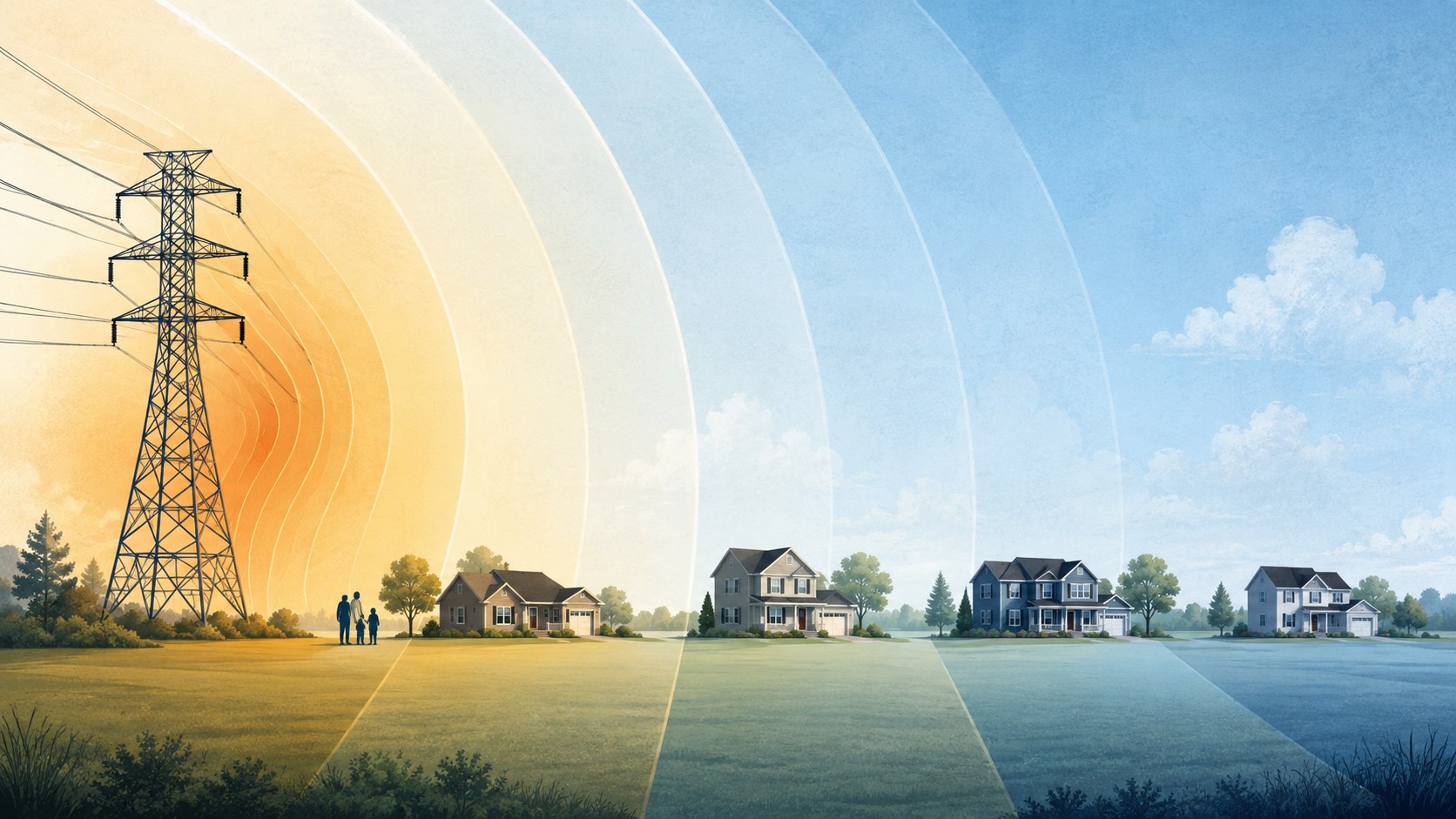
Childhood leukemia
Northern Italy: adjusted OR 2.0 for homes under 100 m versus 400 m or more (95% CI 0.8–5.0).
Only 8 cases were in the closest band. The wide interval included no association, so this result cannot identify who will become ill.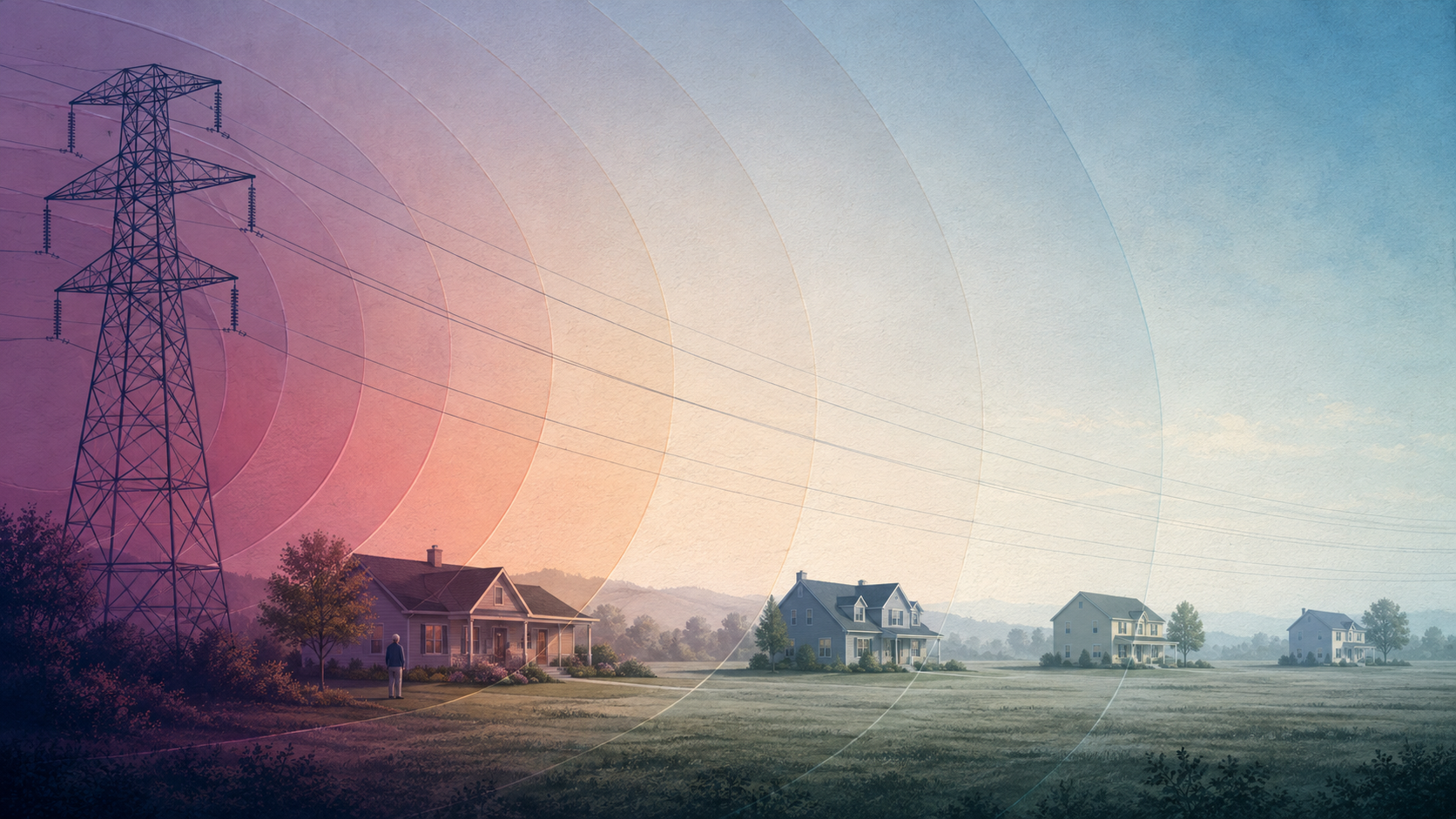
Dementia mortality
Switzerland: HR 1.54 for Alzheimer’s-disease mortality per 1 µT higher modeled long-term exposure (95% CI 1.23–1.92).
The result concerned mortality and modeled exposure, not a diagnosis at a specific distance. Causal inference remains limited.These illustrations are explanatory and not to scale. They do not show an individual probability of illness, a medically established danger zone, or measured exposure at a particular home.
Distance is not dose. Association is not causation.
Distance from a transmission line is a proxy, not a direct magnetic-field measurement. Line voltage, current load, conductor geometry, time spent at home, and other sources can change actual exposure.
A positive result can reflect chance, bias, confounding, or exposure error. A null result does not prove zero risk. Study design, sample size, and confidence intervals matter.
Follow every finding back to its source.
These studies were selected for direct relevance to residential power-line distance, modeled or measured ELF magnetic fields, childhood leukemia, or dementia and neurodegeneration.
Scope note: this is a curated evidence map, not a systematic review or clinical risk calculator. Each item summarizes the published result and its most important limitation.
Five studies central to the research proposal
The two uploaded papers plus three influential studies that shaped the distance, exposure, and duration questions.
What the study reported
The adjusted odds ratio was 2.0 for children living under 100 m from a high-voltage line versus 400 m or more (95% CI 0.8–5.0).
Only 8 cases were in the closest band; the wide interval included no association and does not establish causation.
Malagoli, C., Malavolti, M., Wise, L. A., Balboni, E., Fabbi, S., Teggi, S., Palazzi, G., Cellini, M., Poli, M., Zanichelli, P., Notari, B., Cherubini, A., Vinceti, M., & Filippini, T. (2023). Residential exposure to magnetic fields from high-voltage power lines and risk of childhood leukemia. Environmental Research, 232, 116320. https://doi.org/10.1016/j.envres.2023.116320
What the study reported
Across 3.56 million adults, each 1 µT higher modeled long-term HVPL exposure was associated with Alzheimer’s-disease mortality (HR 1.54, 95% CI 1.23–1.92) and other-dementia mortality (HR 1.31, 95% CI 1.13–1.52).
These are exposure-model estimates for mortality, not distance-band risks or proof that magnetic fields caused disease.
Sandoval-Diez, N., Loizeau, N., Huss, A., Röösli, M., & Vienneau, D. (2026). Long-term residential magnetic field exposure and neurodegenerative disease mortality: An 18-year nationwide cohort study in Switzerland. Environment International, 208, 110145. https://doi.org/10.1016/j.envint.2026.110145
What the study reported
The summary relative risk was 2.00 for estimated residential magnetic fields at or above 0.4 µT (95% CI 1.27–3.13).
Only 44 cases were in the highest exposure category; the authors said selection bias could explain part of the increase.
Ahlbom, A., Day, N., Feychting, M., Roman, E., Skinner, J., Dockerty, J., Linet, M., McBride, M., Michaelis, J., Olsen, J. H., Tynes, T., & Verkasalo, P. K. (2000). A pooled analysis of magnetic fields and childhood leukaemia. British Journal of Cancer, 83(5), 692–698. https://doi.org/10.1054/bjoc.2000.1376
What the study reported
Compared with birth addresses over 600 m away, leukemia relative risk was 1.69 within 200 m (95% CI 1.13–2.53) and 1.23 at 200–600 m (95% CI 1.02–1.49).
The association extended farther than expected for magnetic fields; the authors identified chance or confounding as possible explanations.
Draper, G., Vincent, T., Kroll, M. E., & Swanson, J. (2005). Childhood cancer in relation to distance from high voltage power lines in England and Wales: A case-control study. BMJ, 330(7503), 1290. https://doi.org/10.1136/bmj.330.7503.1290
What the study reported
Alzheimer’s mortality was higher among people who had lived within 50 m of a 220–380 kV line for at least 15 years (HR 2.00, 95% CI 1.21–3.33).
The overall estimate for everyone within 50 m was imprecise (HR 1.24, 95% CI 0.80–1.92), and the study assessed mortality rather than incidence.
Huss, A., Spoerri, A., Egger, M., & Röösli, M. (2009). Residence near power lines and mortality from neurodegenerative diseases: Longitudinal study of the Swiss population. American Journal of Epidemiology, 169(2), 167–175. https://doi.org/10.1093/aje/kwn297
Eleven additional highly relevant studies worldwide
International pooled analyses and residential studies from France, Denmark, Brazil, Italy, Finland, and a five-country transformer study add confirming and countervailing evidence.
What the study reported
Across 12 studies with magnetic-field measurements, the odds ratio was 1.7 above 0.3 µT versus 0–0.1 µT (95% CI 1.2–2.3).
Exposure methods differed among studies, and the pooled association does not identify a causal mechanism.
Greenland, S., Sheppard, A. R., Kaune, W. T., Poole, C., & Kelsh, M. A. (2000). A pooled analysis of magnetic fields, wire codes, and childhood leukemia. Epidemiology, 11(6), 624–634. https://doi.org/10.1097/00001648-200011000-00003
What the study reported
The odds ratio rose to 1.44 at 0.3 µT or more versus under 0.1 µT, but the 95% CI of 0.88–2.36 included no association.
The authors described the newer-study association as weaker and the highest-exposure estimates as imprecise.
Kheifets, L., Ahlbom, A., Crespi, C. M., Draper, G., Hagihara, J., Lowenthal, R. M., Mezei, G., Oksuzyan, S., Schüz, J., Swanson, J., Tittarelli, A., Vinceti, M., & Wünsch-Filho, V. (2010). Pooled analysis of recent studies on magnetic fields and childhood leukaemia. British Journal of Cancer, 103(7), 1128–1135. https://doi.org/10.1038/sj.bjc.6605838
What the study reported
For homes under 50 m from lines of 200 kV or more, the adjusted odds ratio was 1.33 (95% CI 0.92–1.93); calculated magnetic fields were not associated with leukemia.
The small proximity signal was imprecise and was not explained by high modeled magnetic-field exposure.
Amoon, A. T., Crespi, C. M., Ahlbom, A., Bhatnagar, M., Bray, I., Bunch, K. J., Clavel, J., Feychting, M., Hémon, D., Johansen, C., Kreis, C., Malagoli, C., Marquant, F., Pedersen, C., Raaschou-Nielsen, O., Röösli, M., Spycher, B. D., Sudan, M., Swanson, J., … Kheifets, L. (2018). Proximity to overhead power lines and childhood leukaemia: An international pooled analysis. British Journal of Cancer, 119(3), 364–373. https://doi.org/10.1038/s41416-018-0097-7
What the study reported
The pooled odds ratio was 1.01 for exposures at or above 0.4 µT versus under 0.1 µT among 24,994 cases and 30,769 controls.
A meta-analysis spanning three generations of pooled analyses remained imprecise (OR 1.45, 95% CI 0.95–2.20).
Amoon, A. T., Swanson, J., Magnani, C., Johansen, C., & Kheifets, L. (2022). Pooled analysis of recent studies of magnetic fields and childhood leukemia. Environmental Research, 204, 111993. https://doi.org/10.1016/j.envres.2021.111993
What the study reported
Among children under 5, living within 50 m of a high-voltage overhead line was associated with acute leukemia (OR 1.6, 95% CI 1.0–2.7), while modeled exposure at or above 0.3 µT was not (OR 0.6, 95% CI 0.3–1.3).
The authors concluded that magnetic fields probably did not explain the observed distance association.
Mancini, M., Hémon, D., Faure, L., Clavel, J., & Goujon, S. (2025). Residential exposure to magnetic field due to high-voltage power lines and childhood leukemia risk in mainland France—GEOCAP case-control study, 2002–2010. Environmental Research, 278, 121638. https://doi.org/10.1016/j.envres.2025.121638
What the study reported
The odds ratio was 0.76 for living 0–199 m from a 132–400 kV line versus at least 600 m away (95% CI 0.40–1.45).
The study found no higher leukemia risk in either the 0–199 m or 200–599 m distance group.
Pedersen, C., Raaschou-Nielsen, O., Rod, N. H., Frei, P., Poulsen, A. H., Johansen, C., & Schüz, J. (2014). Distance from residence to power line and risk of childhood leukemia: A population-based case-control study in Denmark. Cancer Causes & Control, 25(2), 171–177. https://doi.org/10.1007/s10552-013-0319-5
What the study reported
A 24-hour bedroom measurement at or above 0.3 µT was not associated with ALL (OR 1.09, 95% CI 0.33–3.61); living within 200 m produced an imprecise OR of 1.67 (95% CI 0.49–5.75).
Small numbers and wide intervals limited both the positive and null interpretations.
Wünsch-Filho, V., Pelissari, D. M., Barbieri, F. E., Sant’Anna, L., de Oliveira, C. T., de Mata, J. F., Tone, L. G., Lee, M. L. M., Andréa, M. L. M., Bruniera, P., Epelman, S., Odone Filho, V., & Kheifets, L. (2011). Exposure to magnetic fields and childhood acute lymphocytic leukemia in São Paulo, Brazil. Cancer Epidemiology, 35(6), 534–539. https://doi.org/10.1016/j.canep.2011.05.008
What the study reported
The conditional-model relative risk was 1.1 for apartments above or adjacent to transformer rooms (95% CI 0.3–3.8).
Only 3 highly exposed cases were available, so the authors characterized evidence for an increase as weak but not conclusive.
Crespi, C. M., Sudan, M., Juutilainen, J., Roivainen, P., Hareuveny, R., Huss, A., Kandel, S., Karim-Kos, H. E., Thuróczy, G., Jakab, Z., Spycher, B. D., Flueckiger, B., Vermeulen, R., Vergara, X., & Kheifets, L. (2024). International study of childhood leukemia in residences near electrical transformer rooms. Environmental Research, 249, 118459. https://doi.org/10.1016/j.envres.2024.118459
What the study reported
Ever living within 50 m of a power line was not associated with Alzheimer’s disease overall (HR 1.04, 95% CI 0.69–1.56).
No duration-response pattern was observed; there were only weak age-specific indications.
Frei, P., Poulsen, A. H., Mezei, G., Pedersen, C., Cronberg Salem, L., Johansen, C., Röösli, M., & Schüz, J. (2013). Residential distance to high-voltage power lines and risk of neurodegenerative diseases: A Danish population-based case-control study. American Journal of Epidemiology, 177(9), 970–978. https://doi.org/10.1093/aje/kws334
What the study reported
Within 50 m versus at least 600 m, the odds ratio was 1.11 for Alzheimer’s dementia (95% CI 0.95–1.30) and 1.09 for Parkinson’s disease (95% CI 0.92–1.30).
Both confidence intervals included no association; the authors described the evidence as weak.
Gervasi, F., Murtas, R., Decarli, A., & Russo, A. G. (2019). Residential distance from high-voltage overhead power lines and risk of Alzheimer’s dementia and Parkinson’s disease: A population-based case-control study in a metropolitan area of Northern Italy. International Journal of Epidemiology, 48(6), 1949–1957. https://doi.org/10.1093/ije/dyz139
What the study reported
Living in an apartment adjacent to an indoor transformer station was not associated with Alzheimer’s disease (HR 1.02, 95% CI 0.85–1.22).
This transformer-building design tests residential ELF-MF exposure, but it is not a power-line distance study.
Liimatainen, A., Roivainen, P., Juutilainen, J., Höytö, A., & Naarala, J. (2025). A cohort study on Alzheimer’s disease in relation to residential magnetic fields from indoor transformer stations. Bioelectromagnetics, 46(8), e70031. https://doi.org/10.1002/bem.70031
Help measure what living near the grid really means.
The proposed Region XII Phase 1 study would validate corridor geography, measure residential ELF magnetic fields, and build an ethics-ready foundation for larger epidemiologic research.