
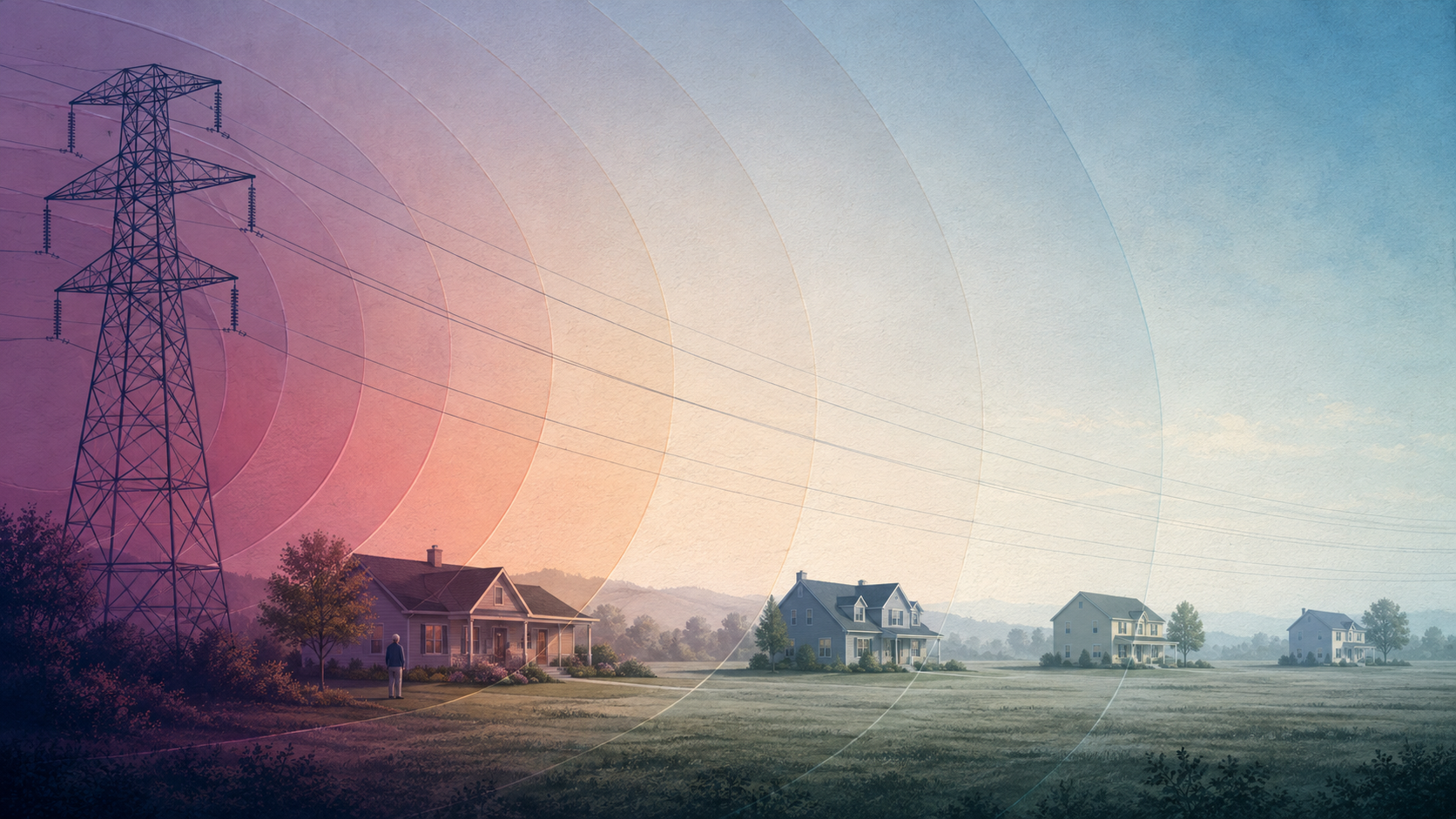
The study followed 3,555,064 adults from 2001–2018, covering 55.4 million person-years and 146,655 neurodegenerative-disease deaths. Exposure was estimated from home location, line type, distance, and time at each residence.
The study’s distance corridors
These bands show how the authors tested whether a simpler distance-based analysis agreed with the modeled-exposure results. Because the uploaded main article does not report a numerical hazard ratio for each band, this page does not invent one.
Used in a sensitivity analysis. The main paper says the distance-corridor pattern was consistent with its modeled-exposure analysis.
Distance served as a proxy for potential long-term exposure; it was not treated as a biological threshold.
The main article does not print a corridor-specific hazard ratio; those estimates are in its supplementary Table S9.
The furthest category in the baseline distance sensitivity analysis, not a guarantee of zero field exposure or zero risk.
Main modeled-exposure results
Hazard ratios below are per 1 µT increase in long-term exposure. That contrast is much larger than the study’s median HVPL exposure of 0.01 µT; only 0.3% of participants had HVPL exposure above 0.30 µT.
Higher in the fully adjusted HVPL model
Higher in the fully adjusted HVPL model
Attenuated after environmental adjustment
No association observed
What “harmful effect” means here
The outcome was mortality recorded on death certificates—not new dementia diagnoses, symptoms, or brain changes. The main association persisted after adjustment for measured social and environmental factors, but observational data can still be affected by residual confounding and exposure error.
Higher modeled HVPL exposure was associated with higher Alzheimer’s and other-dementia mortality in this cohort.
The study found no association for ALS, Parkinson’s disease, or multiple sclerosis.
The authors state that causal inference remains limited by the absence of an established biological mechanism.
Source and editorial note
- Sandoval-Diez N, et al. Long-term residential exposure to extremely low-frequency magnetic fields and mortality from neurodegenerative diseases: A nationwide cohort study. Environment International. 2026;208:110145. Read the open-access paper
Source review completed 3 September 2026 from the supplied paper. The illustration is explanatory and not to scale. No independent expert review is claimed. This page is general information, not medical, environmental, property, or legal advice.