
Medical research teams often begin an analysis meeting by asking which test to use. That question is premature. A t test, regression model, mixed model, or survival analysis can estimate a defined quantity, but it cannot decide which clinical effect the study was meant to learn.
When the objective is vague, technically correct analyses can answer different questions. One analyst may compare everyone as randomized; another may exclude treatment discontinuations; a third may censor rescue therapy. The outputs can all look polished while targeting different effects. ICH E9(R1) reverses the usual order: clarify the trial objective and treatment effect of interest, account for intercurrent events, and then let those choices guide design, data collection, and analysis.
01Turn the objective into an estimand
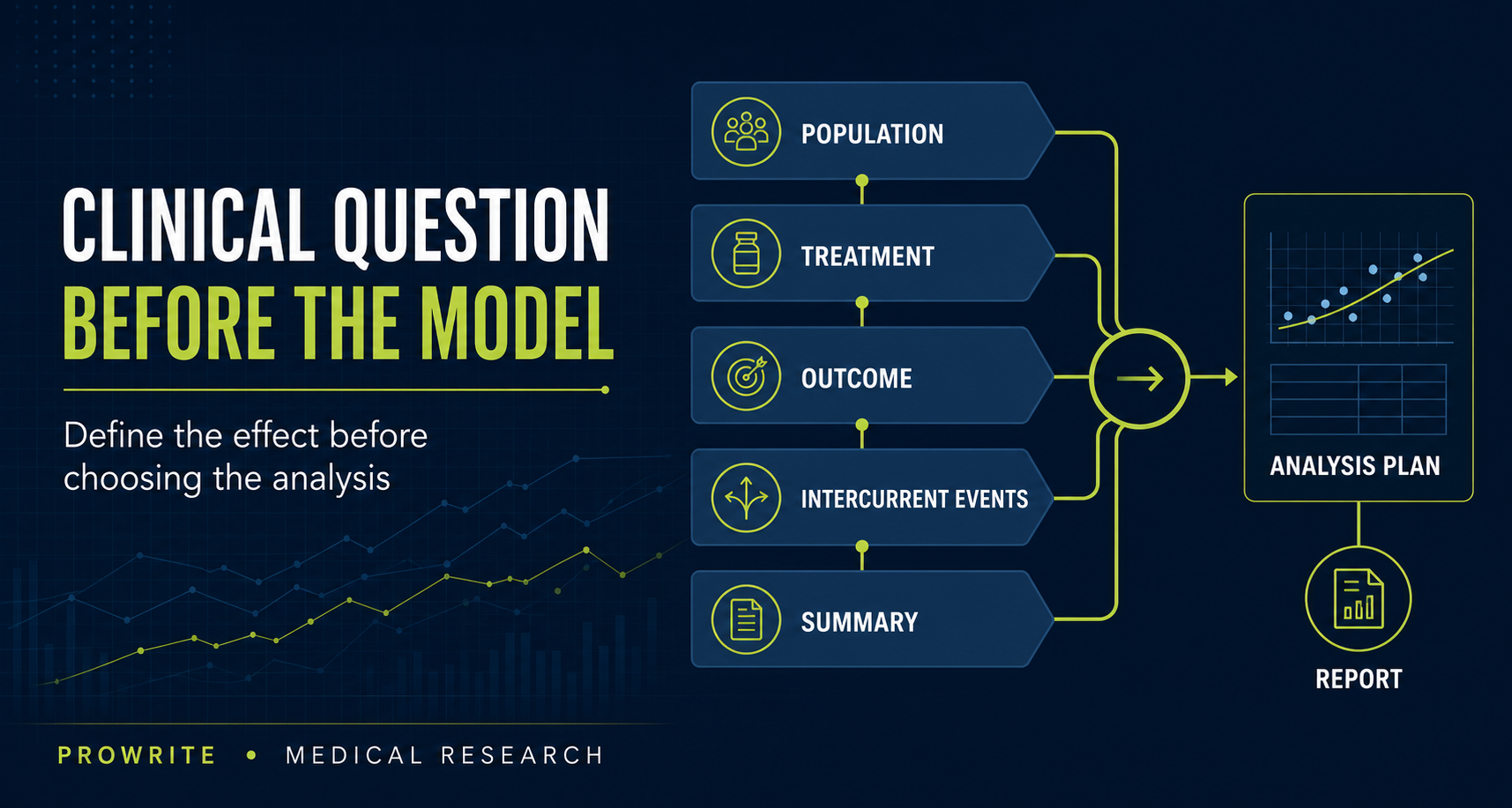
An estimand is a precise description of what is to be estimated. A practical working record should identify five connected elements: the treatment conditions being compared; the target population; the outcome variable and time point; the way intercurrent events will be handled; and the population-level summary, such as a mean difference, risk ratio, or hazard-based contrast.
Consider a trial evaluating a glucose-lowering treatment at 12 months. “Does the treatment lower HbA1c?” leaves important decisions unstated. Is the target everyone eligible for the trial? Is the variable the final HbA1c or change from baseline? Does the comparison include values after rescue medication or discontinuation? Is the summary a difference in means or the proportion reaching a prespecified target? Each answer changes the scientific meaning before it changes the mathematics.
02Treat intercurrent events as scientific decisions
Intercurrent events occur after treatment begins and affect how an outcome should be interpreted or whether it exists. Examples include rescue medication, treatment switching, discontinuation, or death before a planned measurement. These events are not automatically “missing data.” A measurement after rescue therapy may be observed, but it reflects a different treatment pathway. A post-death measurement does not exist.
The protocol should therefore state which events matter and what question each handling strategy represents. A treatment-policy approach may use the outcome regardless of rescue therapy. A hypothetical approach may target what would have happened without rescue. A composite strategy may incorporate the event into the outcome definition. There is no universally correct choice: the choice must match the decision the study is intended to inform.
03Choose an estimator only after the target is fixed
The estimand is the target; the estimator is the analytical method used to estimate it from data. Confusing them leads teams to define the question by software defaults. A mixed model does not decide whether post-discontinuation outcomes belong in the target. Multiple imputation does not decide which hypothetical scenario is clinically meaningful. A per-protocol set does not automatically identify the effect among adherent participants and may introduce post-randomization selection bias.
Once the target is explicit, the team can select a compatible estimator, document assumptions, and prespecify sensitivity analyses that challenge those assumptions while addressing the same estimand. A second analysis aimed at a different treatment effect can be useful, but it should be labeled as a supplementary estimand rather than presented as confirmation of the first.
04Make every study document tell the same story
SPIRIT 2025 defines the protocol as the central record of a randomized trial and encourages consistency across the protocol, statistical analysis plan, and registry. Its outcome guidance asks teams to specify the measurement variable, analysis metric, aggregation method, and time point. The statistical analysis plan then adds executable detail; it should not quietly redesign the objective after data are available.
Alignment should be checked across five locations: the objective, outcome definition, schedule of assessments, analysis population and method, and final result statement. If the objective targets 12-month function regardless of treatment discontinuation, data collection should continue after discontinuation where ethical and feasible. If the report excludes those observations, the conclusion no longer answers the planned question.
05Use a question-to-analysis gate
Before approving a sample-size calculation or model specification, require a one-page estimand record. Ask whether the treatment conditions, population, variable, time point, intercurrent-event strategies, and summary measure can be explained without naming statistical software. Then map each element to required data, estimator assumptions, sensitivity analyses, and the wording of the future conclusion.
This gate does not eliminate judgment; it makes judgment visible. It gives clinicians, statisticians, data managers, and investigators a shared object to review before irreversible design and collection choices are made. The result is not merely a cleaner analysis plan. It is a study whose final number has a stable scientific meaning.
References
- International Council for Harmonisation. E9(R1) Statistical Principles for Clinical Trials: Addendum on Estimands and Sensitivity Analysis in Clinical Trials. FDA final guidance, 2021. ↗ Accessed 26 July 2026.
- Chan A-W, et al. SPIRIT 2025 Statement: Updated Guideline for Protocols of Randomized Trials. JAMA. 2025;334(5):435–443. ↗ Accessed 26 July 2026.
- Hróbjartsson A, et al. SPIRIT 2025 explanation and elaboration: updated guideline for protocols of randomised trials. BMJ. 2025;389:e081660. ↗ Accessed 26 July 2026.
- World Health Organization. Guidance for best practices for clinical trials. 2024. ↗ Accessed 26 July 2026.
- Gamble C, et al. Guidelines for the Content of Statistical Analysis Plans in Clinical Trials. JAMA. 2017;318(23):2337–2343. ↗ Accessed 26 July 2026.
This article is educational and for research purposes. It does not provide individual medical advice. No patient data were used.