
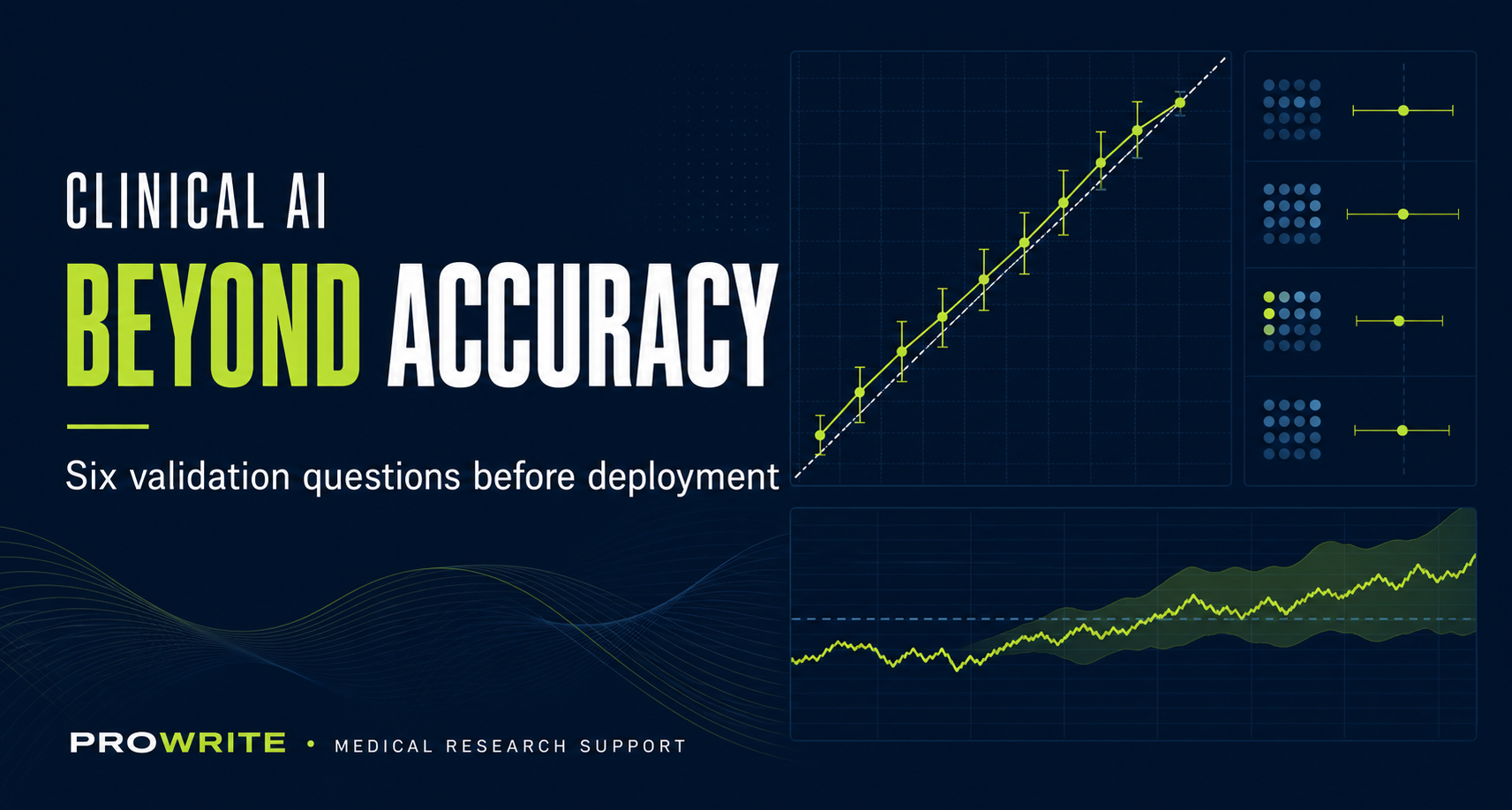
A high area under the receiver operating characteristic curve can be impressive, but it does not prove that a clinical AI model is ready to guide care. Accuracy is only one part of a broader validation argument: the model must estimate risk appropriately, work in the intended population, support a useful decision, fit the clinical workflow, and remain reliable after deployment.
The distinction matters because prediction models do not act in isolation. Their outputs may change who receives a diagnostic test, treatment, referral, or follow-up. A technically strong model can therefore cause harm if its intended use is vague, its probabilities are miscalibrated, or its performance changes silently in a new setting. Before deployment, a research team should be able to answer six questions with evidence.
01What decision is the model intended to support?
Validation begins with intended use, not a metric. The team should define the target population, clinical setting, intended user, input data, predicted outcome, time horizon, and action linked to the output. “Predict deterioration” is not specific enough. The operational question is who will see the prediction, when they will see it, and what different action becomes reasonable because of it.
TRIPOD+AI emphasizes transparent reporting of both regression and machine-learning prediction models. PROBAST+AI then helps reviewers judge quality, risk of bias, and applicability. These frameworks make an important point: excellent performance in an irrelevant population or for an undefined decision is not useful validation.
02Are predicted probabilities calibrated?
Discrimination asks whether people with an outcome tend to receive higher predicted risks than people without it. Calibration asks whether the probabilities themselves agree with observed outcomes. A model may rank patients correctly while systematically overstating or understating their actual risk.
That difference becomes critical when an intervention is triggered at a threshold. Teams should examine a smoothed calibration plot, calibration-in-the-large, and calibration slope with uncertainty—not rely only on one summary statistic. Calibration should also be assessed across the clinically relevant risk range, because acceptable average performance can conceal dangerous errors near a decision threshold.
03Does the model transport to the intended setting?
Internal validation estimates optimism within the development data. It does not establish that the model will work in another hospital, region, device environment, or patient mix. External validation uses data that are independent of model development and should represent the place where the model is meant to be used.
The validation report should compare eligibility criteria, outcome definitions, measurement methods, missingness, prevalence or event rates, and predictor distributions between development and validation samples. If performance changes, the team should investigate whether recalibration, model updating, narrower use, or non-deployment is the responsible response.
04Is performance acceptable across important subgroups?
Overall performance can hide clinically meaningful failure in a smaller group. Subgroup analyses should be defined from the intended use and plausible sources of variation—for example sex, age, ethnicity, geography, care setting, disease severity, acquisition device, or data-availability pattern.
Researchers should report the number of participants and outcome events in each subgroup and show uncertainty around calibration, discrimination, sensitivity, specificity, and error rates as appropriate. Small samples should not be treated as proof of equivalence. They are a reason to state uncertainty and collect better evidence.
05Does the model improve decisions in the real workflow?
Predictive performance is not the same as clinical utility. Decision-curve analysis can estimate net benefit across prespecified thresholds and compare model-guided action with alternatives such as treating everyone, treating no one, or using an existing rule. Thresholds should reflect clinical expertise, patient priorities, benefits, harms, and resource constraints.
Early clinical evaluation should also examine human factors. DECIDE-AI highlights the importance of workflow integration, user characteristics, training, safety, and the interaction between clinicians and the AI system. A model that is ignored, misunderstood, over-trusted, or presented too late cannot deliver its theoretical value.
06How will performance be monitored after deployment?
Clinical environments change. Coding practices, devices, treatment pathways, patient populations, and outcome frequencies may drift. Software versions may also change. The International Medical Device Regulators Forum's 2025 Good Machine Learning Practice principles use a total-product-lifecycle perspective, while WHO regulatory considerations address performance evaluation and monitoring.
A monitoring plan should name the model version, data and outcome windows, performance measures, subgroup checks, review frequency, alert thresholds, responsible owners, and escalation actions. It should also define when a model will be recalibrated, suspended, rolled back, or formally revalidated. Monitoring without a decision pathway is only observation.
Validation is a lifecycle argument
A defensible clinical AI model is not the one with the most impressive metric. It is the one whose intended use is explicit, whose probabilities are calibrated, whose performance travels to the target setting, whose important subgroups are examined, whose decisions create net benefit, and whose behavior remains visible after deployment.
That evidence should be versioned, reproducible, and understandable to clinicians, data scientists, ethics and governance teams, and the patients affected by the resulting decisions. Clinical AI validation is therefore not a final box to check. It is an accountable process that continues for as long as the model can influence care.
References
- Collins GS, et al. TRIPOD+AI statement: updated guidance for reporting clinical prediction models. BMJ. 2024;385:e078378. ↗ Accessed 26 July 2026.
- Moons KGM, et al. PROBAST+AI: an updated quality, risk-of-bias, and applicability assessment tool. BMJ. 2025;388:e082505. ↗ Accessed 26 July 2026.
- Riley RD, et al. Evaluation of clinical prediction models (part 2): how to undertake an external validation study. BMJ. 2024;384:e074820. ↗ Accessed 26 July 2026.
- International Medical Device Regulators Forum. Good Machine Learning Practice for Medical Device Development: Guiding Principles. 2025. ↗ Accessed 26 July 2026.
- World Health Organization. Regulatory considerations on artificial intelligence for health. 2023. ↗ Accessed 26 July 2026.
- Vasey B, et al. Reporting guideline for the early-stage clinical evaluation of AI decision support systems: DECIDE-AI. Nature Medicine. 2022;28:924–933. ↗ Accessed 26 July 2026.
This article is for research education and does not provide individual medical advice. No patient data were used.